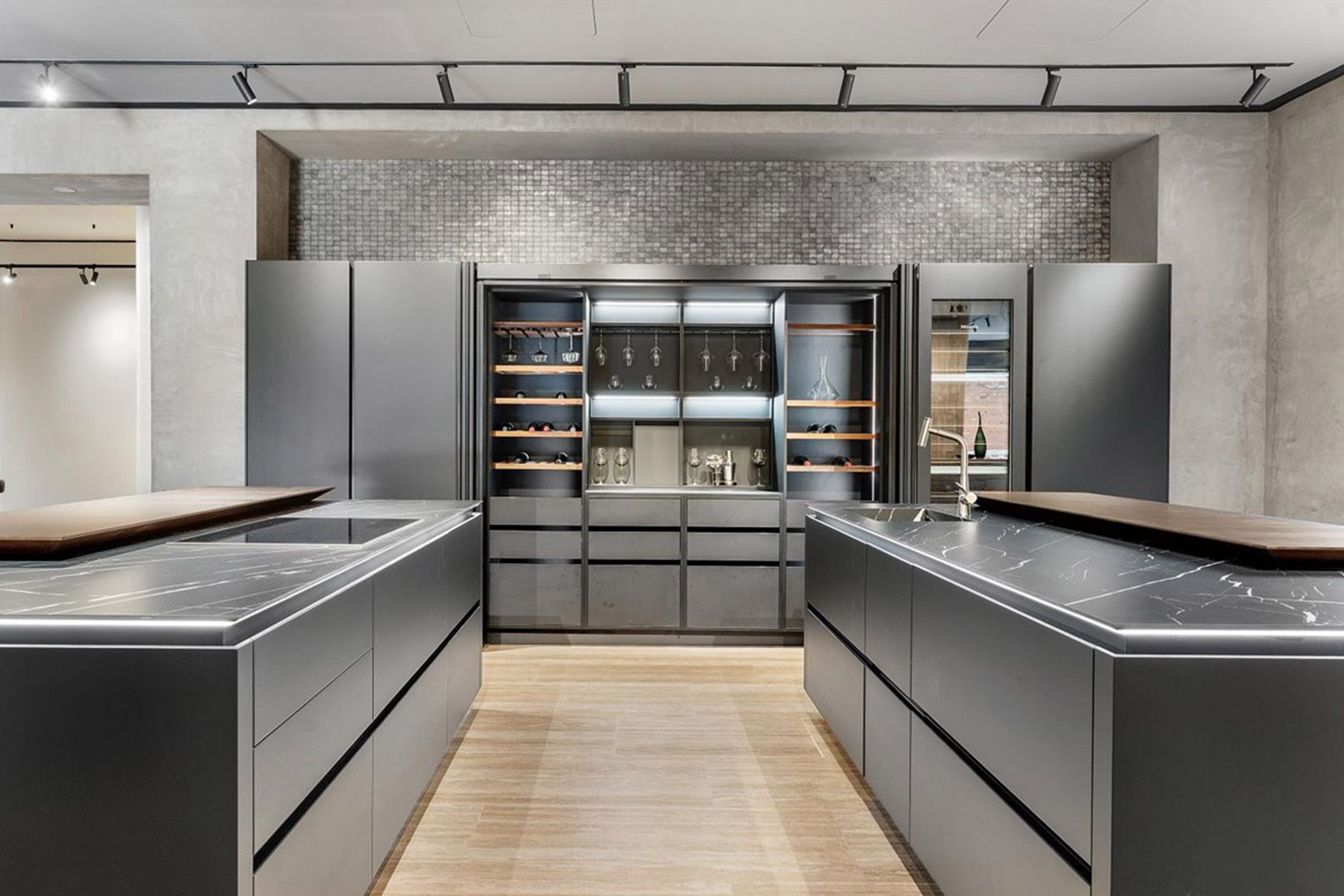
Top Kitchen Design Showrooms in America: A Professional Evaluation Guide
The process of constructing a luxury culinary environment is fundamentally a process of rigorous selection. Homeowners, architects, and design professionals must translate abstract concepts into durable, functional reality. Top Kitchen Design Showrooms in America. This transition often centers on the design showroom, a space that functions far beyond its role as a retail display. In the current landscape of high-end residential construction, these environments serve as critical nodes where material science, architectural ergonomics, and aesthetic aspiration converge. Choosing the right partner for this journey is arguably the most consequential decision in the renovation lifecycle.
Professional design showrooms operate as laboratories of possibility. They provide the necessary tactile and sensory context that digital media cannot replicate. When engaging with these spaces, it is essential to look past the immediate visual appeal of a display. True quality in a design partnership is revealed through the technical depth of the team, the precision of the manufacturing partners, and the showroom’s commitment to long-term project viability. The best showrooms act as conduits for specialized knowledge, guiding clients through the intricacies of spatial planning, utility integration, and finish performance.
This analysis explores the systemic importance of design showrooms in American residential architecture. It examines the criteria that distinguish truly elite facilities, the mental models required to evaluate them, and the logistical realities of high-end renovation. By moving beyond a superficial directory, this article provides a framework for understanding how elite showrooms facilitate the creation of culinary spaces that serve as enduring assets within a home’s structural and financial architecture.
Understanding “top kitchen design showrooms in america”
Defining the “top kitchen design showrooms in america” requires a shift in perspective. These are not stores selling cabinets; they are hubs for architectural coordination. A common misunderstanding in the broader market is that these showrooms exist merely to provide aesthetic inspiration. While inspiration is an output, the primary function is the management of risk. An elite showroom provides technical rigor. It ensures that the proposed design respects the structural capacity of the floor, the ventilation requirements of high-output appliances, and the ergonomics of daily use.
Oversimplification poses a significant risk to high-end renovation. When owners select a showroom based solely on aesthetic trends or brand prestige, they often neglect the critical backend support that ensures the project finishes as planned. A showroom’s reputation should be built on its ability to manage the logistics of international shipping, coordinate with local trade professionals, and resolve site-specific issues without degrading the design intent. Elite showrooms understand that they are managing a multi-part integration project where the failure of a single component—such as a hinge or a concealed runner—can compromise the entire system’s functionality.
The Problem of Superficial Evaluation
Evaluating showrooms based on visual polish alone is insufficient. Many facilities curate beautiful environments that hide poor workmanship. A deep evaluation requires inspecting the mechanical fidelity of the displays: the consistency of door gaps, the smoothness of drawer operation, and the quality of edge-banding. If the displays themselves are not flawlessly maintained, it is a leading indicator that the company lacks the operational discipline required for a complex residential installation.
Contextual Intelligence and Localized Expertise
The best showrooms demonstrate contextual intelligence regarding the regional building codes and architectural vernacular of their location. Whether it is navigating the specific logistical constraints of an urban penthouse or accommodating the framing nuances of a historic estate, a top-tier showroom partner acts as a local expert. This regional awareness is crucial. It ensures that the materials selected are not only beautiful but also capable of performing under local environmental conditions—such as humidity levels or structural shifting—that can cause standard installations to fail prematurely.
The Evolution of the Design Showroom as a Technical Hub
Historically, kitchen design facilities were essentially wood shops with small display areas. They focused on custom fabrication rather than systemic integration. As appliance technology advanced and the kitchen transitioned into a focal point of the American home, the showroom model had to adapt. The modern high-end showroom now functions as an integration center, blending custom millwork with complex, technology-heavy appliance suites.
This evolution mirrors the broader changes in residential architecture, where the kitchen has become the central nervous system of the house. The modern showroom must now facilitate a dialogue between the interior designer, the architect, the general contractor, and the homeowner. This convergence of interests requires the showroom team to possess not just design flair, but project management expertise. They must speak the language of construction and maintain enough technical depth to provide guidance on subfloor preparation, electrical load requirements, and ventilation ducting.
Conceptual Frameworks for Showroom Evaluation
To evaluate these spaces, stakeholders should apply specific mental models that prioritize durability and risk mitigation.
The Systemic Integration Framework
This framework evaluates a showroom based on its ability to manage the kitchen as a cohesive machine. A showroom earns its status by demonstrating how cabinetry, appliances, and surfaces integrate into a unified system. It is not enough for the cabinets to be of high quality if they are not designed to interface perfectly with the appliance suite’s thermal and spatial requirements.
The Total Lifecycle Value Model
This model assesses the investment not at the point of sale, but over the duration of the installation’s life. A top-tier showroom partner emphasizes longevity. They provide clear documentation on maintenance requirements and offer robust support long after the project’s completion. They view the sale as the beginning of a long-term relationship, recognizing that the kitchen’s performance is a reflection of their own reputation.
The Logistics and Site-Readiness Standard
Elite showrooms understand that the design is only as good as its execution on-site. They evaluate the project’s site-readiness before accepting any responsibility. This means they confirm that structural walls are plumb, utility lines are correctly positioned, and subfloors are level. By requiring this validation, they reduce the risk of installation-day surprises, protecting the client from the compounding costs of delay.
Taxonomy of Showroom Specializations
Design showrooms can be classified by their primary operational focus. Understanding these categories is essential for matching one’s project requirements with the right facility.
| Specialization Category | Operational Focus | Key Advantage |
| Bespoke Millwork Atelier | Custom fabrication and artisanal detail | Unmatched material customization |
| European Systems Integrator | Precision modular engineering | High performance, consistent tolerances |
| Integrated Appliance Center | Technical appliance specification | Superior mechanical integration |
| Architectural Project Management | Holistic renovation oversight | Single point of accountability |
| Full-Service Design Gallery | Aesthetic curation and space planning | High-concept, cohesive visual results |
Decision Logic for Partner Selection
The selection process should be guided by the project’s specific constraints. If the renovation involves significant structural alteration or requires a highly complex, non-standard layout, a showroom with strong architectural project management capabilities is essential. Conversely, if the project is primarily a cabinet replacement within a stable structural footprint, a European systems integrator may offer the best balance of speed, precision, and performance.
Real-World Spatial Scenarios and Structural Constraints Top Kitchen Design Showrooms in America
Scenario 1: The Historical Renovation Conflict
A client intends to install ultra-modern, precision-engineered cabinetry in a historic home with sagging timber floors. A lower-tier showroom might ignore the site conditions, leading to an installation that is impossible to level. An elite showroom will proactively design a sub-frame system to compensate for the floor’s geometry, ensuring the cabinetry retains its functional precision.
Scenario 2: The High-Rise Logistics Puzzle
In an urban high-rise, materials must be moved through restricted freight elevators. The failure mode is the purchase of pre-assembled, oversized units that cannot fit. An experienced showroom manages the logistical constraints, specifying modular delivery that allows for easy assembly in the field without compromising the design’s visual integrity.
Financial Architecture, Cost Structures, and Resource Logistics
Renovation costs involve more than the sticker price of the materials. The true financial commitment includes the design fee, the installation labor, and the potential contingency costs arising from unforeseen structural issues.
| Resource Category | Cost Driver | Variability Index |
| Custom Millwork | Labor and material grade | High |
| Modular Systems | Manufacturing precision | Moderate |
| Appliance Integration | Technical complexity | High |
| Project Management | Site oversight requirements | Moderate |
Professional showrooms clarify these costs early, ensuring that the budget reflects the reality of the work involved. They avoid the “low-ball” approach, which typically masks hidden costs that emerge during the construction phase.
The Risk Landscape and Failure Modes
The primary risk in kitchen design is the “gap of accountability”—where the cabinet manufacturer, the appliance dealer, and the contractor disagree on who is responsible for a technical failure. Top-tier showrooms mitigate this risk by accepting responsibility for the interface between these systems. They maintain a taxonomy of failure modes—such as hardware fatigue, finish delamination, or improper ventilation—and implement design standards that prevent these issues from occurring in the first place.
Governance, Lifecycle Maintenance, and Adaptation Cycles
A project’s success should be monitored through a formal governance cycle. This includes:
-
Design-Phase Validation: Reviewing all mechanical and structural plans against site measurements.
-
Installation Oversight: Implementing an on-site quality assurance protocol during the critical cabinetry setting phase.
-
Post-Installation Handover: Providing the owner with comprehensive maintenance manuals and a schedule for periodic hardware adjustments.
This governance ensures the kitchen remains a high-performance asset rather than a depreciating aesthetic element.
Measurement, Performance Signals, and Analytical Evaluation
How do we measure the success of a showroom partnership?
-
Leading Indicators: The showroom’s ability to identify site issues before materials arrive.
-
Lagging Indicators: The frequency of post-installation service calls.
-
Qualitative Signals: The ease of interaction with the staff and the transparency of the communication process.
Elite showrooms keep detailed documentation logs for each project. These logs provide the data needed to evaluate performance objectively and support the homeowner in the long term.
Industry Misconceptions and Structural Oversimplifications
-
“Showroom-Only” Advantage: The idea that you must visit every showroom in your area is inefficient. Start by narrowing your search based on the technical depth of the team.
-
The Price-Quality Correlation: High price does not always equate to high functional performance. Look for technical durability instead.
-
Appliance Independence: Thinking the kitchen designer doesn’t need to know about your appliances is dangerous. Appliances dictate the structural and thermal requirements of the entire room.
-
Aesthetics Over Ergonomics: A beautiful kitchen that is poorly laid out will be a source of constant frustration.
Strategic Synthesis and Future Pathways
The selection of a design showroom is a proxy for the success of the renovation project itself. By prioritizing technical competence and project management discipline, stakeholders secure a result that is both aesthetically resonant and operationally robust. The future of this industry lies in greater transparency, enhanced digital modeling, and a deeper integration of building science into the design process. Those who seek the best showrooms will ultimately find partners who do not just sell products, but curate long-term structural and functional value.