Best Cabinet Layout Options: Structural Planning and Space Optimization
The optimization of interior spatial architecture requires a careful balance between structural constraints and human ergonomics. When designing or renovating a kitchen, the arrangement of casework determines the flow of physical movement. It dictates the efficiency of daily tasks and the long-term utility of the space. Selecting a configuration is not merely an aesthetic choice. Best Cabinet Layout Options. It is a complex design decision that alters how a primary living area functions for decades.
Historically, residential design treated cabinetry as isolated furniture pieces rather than an integrated system. Modern architecture has shifted this perspective. Designers now view storage and work surfaces as foundational infrastructure. Because the built environment must accommodate fixed plumbing lines, structural columns, and electrical conduits, a layout must adapt to the unique limitations of a specific floor plan. This architectural reality requires a thorough analysis of spatial dynamics before selecting materials or manufacturing specifications.
A successful installation depends on understanding how physical volumes interact within an enclosed perimeter. Miscalculating clearances, workflow pathways, or storage accessibility can lead to chronic operational friction. It can accelerate the wear of mechanical components and reduce the usability of the room. Consequently, selecting the appropriate framework requires looking past superficial style trends. Planners must focus on the underlying principles of spatial geometry and motion.
This study analyzes the structural configurations, ergonomic models, and planning methodologies that govern modern casework design. By focusing on mechanical constraints, user workflows, and long-term adaptation, this guide provides a definitive reference framework. It helps architects, interior designers, and property owners who need to evaluate, plan, and execute highly functional residential projects.
Understanding “best cabinet layout options”
The phrase “best cabinet layout options” is frequently oversimplified in consumer media and retail marketing campaigns. It is often reduced to a simple choice between standard geometric configurations like the L-shape or the U-shape. Within the context of professional interior architecture and space planning, however, the concept demands a far more complex definition. It represents the optimal coordination of physical volumes, clearance zones, and activity centers within a defined architectural boundary. This must be achieved without compromising structural integrity, reducing mechanical access, or violating local building codes.
A true optimization process looks past superficial visual patterns to evaluate the ratio of usable storage volume to unencumbered clearance space. A specific arrangement may provide maximum linear footage of counter space, yet fail completely if it restricts the door swing of major appliances or blocks primary pathways. Therefore, evaluating options requires identifying the specific spatial limits of a home rather than relying on generalized templates.
A foundational hierarchy of kitchen layout planning begins with the primary architectural boundary. This layer accounts for fixed structural walls, plumbing stacks, and utility access points that cannot easily be relocated. Below this sits the clearance zone calculation layer, which defines the physical space required for appliance doors to open, walkways to remain clear, and users to pass safely. The final layer is the ergonomic accessibility zone, which focuses on the placement of countertops, active preparation surfaces, and storage zones within natural human reach limits.
When analyzing these configurations, planners often mistake raw storage volume for genuine utility. Deep corner bases may look efficient on a two-dimensional blueprint, but they can quickly become inaccessible dead zones without specialized interior hardware. Conversely, a minimalist configuration with less total footage can achieve higher functional efficiency. This happens if it aligns perfectly with the user’s natural movement patterns. Implementing these structural adjustments requires balancing complex trade-offs between different zones. For example, extending upper units to a high ceiling maximizes long-term storage, but it increases the reliance on step stools and alters the visual scale of the room.
The Architectural and Functional Evolution of Storage Spaces
The organization of residential food preparation and storage areas was largely unstandardized prior to the twentieth century. Early domestic spaces relied on freestanding furniture, such as meat safes, dresser tables, and independent pantry cupboards. These pieces were rearranged based on immediate needs rather than a planned workflow. This fragmented approach shifted with the onset of industrialization and the systematic study of domestic labor efficiency.
The foundational shift toward standardized, built-in cabinetry occurred during the 1920s, most notably marked by the development of the Frankfurt Kitchen by Margarete Schütte-Lihotzky. This design applied contemporary factory efficiency models to the home, establishing unified counter heights, fixed storage locations, and narrow, optimized work paths. This development treated the kitchen as a functional laboratory, proving that calculated layout choices could drastically reduce the physical exertion and time required for daily household tasks.
During the post-war housing boom of the 1950s and 1960s, manufacturing processes evolved to support mass-produced, modular casework units. This era introduced standard dimensional increments, allowing builders to quickly spec and install uniform runs of base and wall units. However, because energy and square footage were relatively inexpensive during this expansion, layouts often prioritized rapid installation over custom spatial optimization. This resulted in repetitive, formulaic floor plans that frequently included deep, hard-to-reach corners and inefficient appliance spacing.
Today, the planning of storage configurations faces a major shift driven by open-concept architecture and the integration of smart home technology. Modern living patterns have removed the physical walls separating preparation areas from dining and living spaces. This integration means cabinetry must function both as high-utility storage and as a major architectural element that coordinates with adjacent rooms. Consequently, the contemporary definition of an optimized plan has evolved from a closed, isolated work cell into a multi-functional zone that manages traffic, supports socialization, and integrates complex built-in appliances seamlessly.
Ergonomic Frameworks and Work Flow Models
To successfully evaluate layout options across diverse architectural conditions, designers must look past subjective preferences and rely on established mental models rooted in ergonomics and kinetic movement.
The Classic Work Triangle
The most enduring mental model for space planning is the Classic Work Triangle, developed in the 1940s by the University of Illinois School of Architecture. This framework connects the three primary activity hubs: the refrigerator (storage), the sink (preparation/cleaning), and the range (cooking).
The model dictates that the sum of the three legs of the triangle should not exceed 26 feet, and no single leg should measure less than 4 feet or more than 9 feet. This geometric constraint ensures that the user can move efficiently between tasks without walking excessive distances, while still leaving enough counter space near each appliance to work comfortably.
Work Zone Theory
While the Work Triangle remains a useful baseline, modern spatial planning often uses Work Zone Theory to accommodate larger, more complex open-concept spaces. This mental model divides the cabinetry run into five distinct functional zones:
-
Consumables (refrigerated and dry food storage)
-
Non-Consumables (dishes, glassware, and storage containers)
-
Cleaning (sink, dishwasher, and waste management)
-
Preparation (continuous counter space, mixing bowls, and utensils)
-
Cooking (range, oven, and specialized cookware)
By grouping cabinetry hardware, accessories, and organizers around these specific zones, designers can create self-contained work centers that minimize movement across the room, allowing multiple users to operate simultaneously without interference.
The Boundary Control Model
The Boundary Control Model treats cabinetry installations as dynamic physical barriers that direct human traffic through a home. In open floor plans, the placement of island units and tall utility towers serves a dual purpose. They provide essential storage while physically blocking guests or children from entering dangerous hot zones near cooking surfaces. This perspective shifts the focus from simple storage density to the broader management of household traffic patterns.
The Law of Vertical Stratification
The Law of Vertical Stratification provides a framework for organizing items based on accessibility and weight constraints. Storage volumes are divided into three clear vertical zones: the primary ergonomic zone (between the knuckles and shoulders of the user), the secondary low zone (below the knuckles to the floor), and the tertiary high zone (above the shoulders to the ceiling).
Applying this framework means standard configurations must allocate deep drawers in base units for heavy pots, open counters for daily tasks, and high wall units or valance shelving for seasonal items. This minimizes repetitive bending and reaching, protecting the user from physical strain.
Comprehensive Taxonomy of Structural Configurations
Casework configurations are not uniform. To deploy capital and structural resources effectively, layouts must be categorized by their geometric configurations and structural behaviors. Each layout features unique performance trade-offs that dictate its suitability for a given architectural floor plan.
One-Wall Layouts
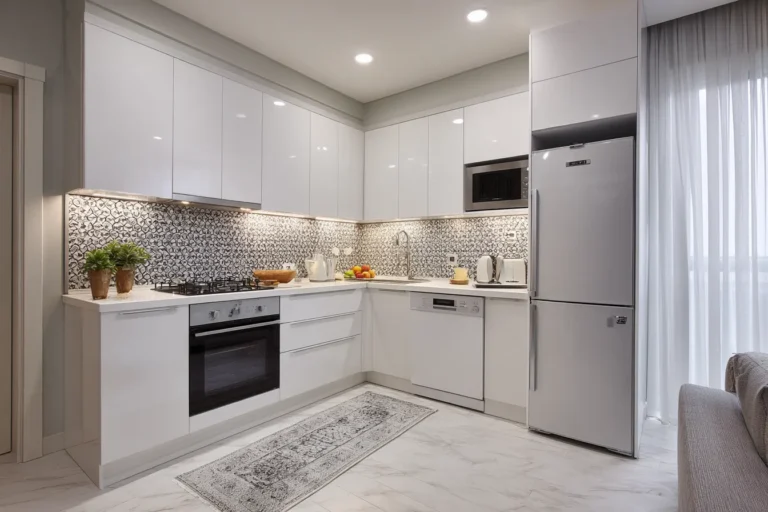
The one-wall layout aligns all storage, counter surfaces, and appliances along a single linear vertical boundary. This configuration is highly efficient for narrow, long spaces, urban loft apartments, or secondary auxiliary suites.
The primary advantage is its minimal footprint, which completely eliminates hard-to-reach corner cabinetry and lowers material expenses. The main trade-off is a significant reduction in continuous prep counters and an elongated work path that violates traditional triangle rules by placing all stations in a straight line.
Galley Layouts
The galley configuration uses two parallel walls of cabinetry facing each other across a central walkway. Long favored by professional chefs and maritime designers for its high spatial efficiency, this plan places all major zones within a brief step or pivot of the user.
The structural trade-off requires maintaining a minimum clearance of 48 inches between opposing base units to allow multiple doors and drawers to open without colliding. While it maximizes linear counter space, it can feel isolating if both ends are closed off from the rest of the home.
L-Shaped Layouts
The L-shaped framework routes cabinetry along two perpendicular walls, creating a flexible, open floor plan that naturally accommodates a central dining table or independent island unit. This configuration solves the isolation issue of the galley by opening one side of the workspace to an adjacent living area.
The primary engineering challenge centers on the single intersection point where the two walls meet. This corner requires specialized internal hardware, such as a lazy susan or blind-corner pull-out trays, to prevent the deep space from becoming unusable.
U-Shaped Layouts
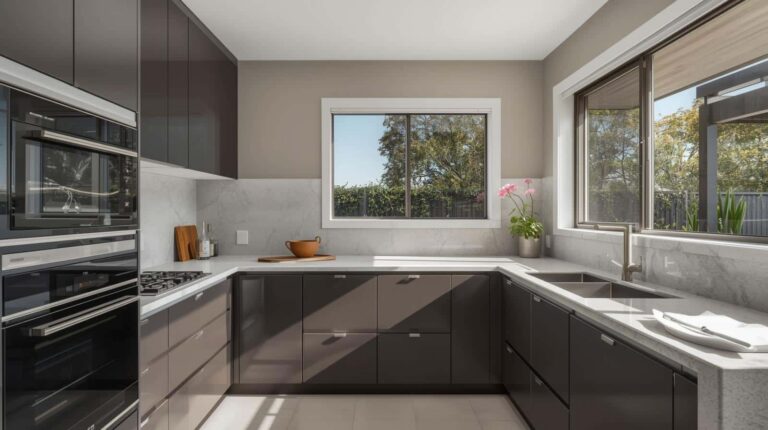
The U-shaped configuration features three continuous walls of cabinetry that completely encircle the primary user. This setup provides maximum storage and counter surfaces within a compact area, making it ideal for dedicated cooking spaces.
However, this high density introduces two separate blind corners, which increases hardware budgets significantly. Additionally, if the central clearance zone is less than 60 inches wide, the space can feel cramped when multiple people try to use it at the same time.
G-Shaped Layouts
The G-shaped layout extends the U-shaped concept by adding a fourth partial wall or peninsula unit near the entrance of the workspace. This peninsula increases counter space and storage capacity while creating a distinct separation from surrounding rooms.
The clear risk with this layout is access control. The partial wall creates a single, narrow entry and exit point, which can easily trap traffic during busy gatherings or meal prep.
Island Configurations
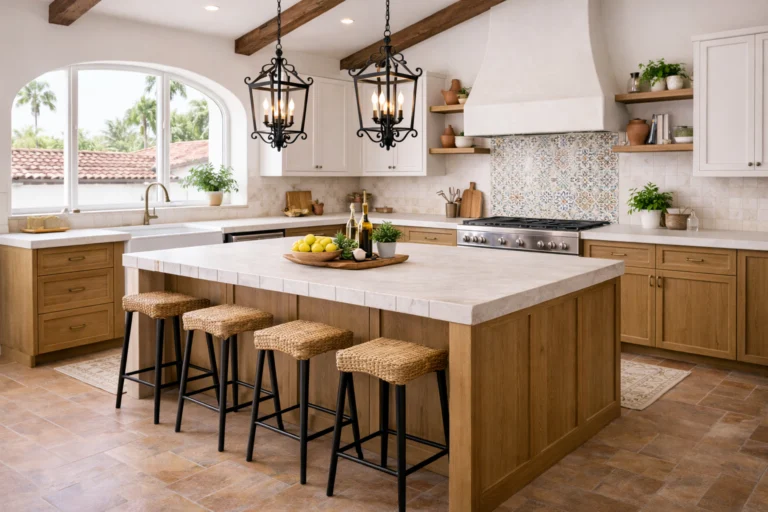
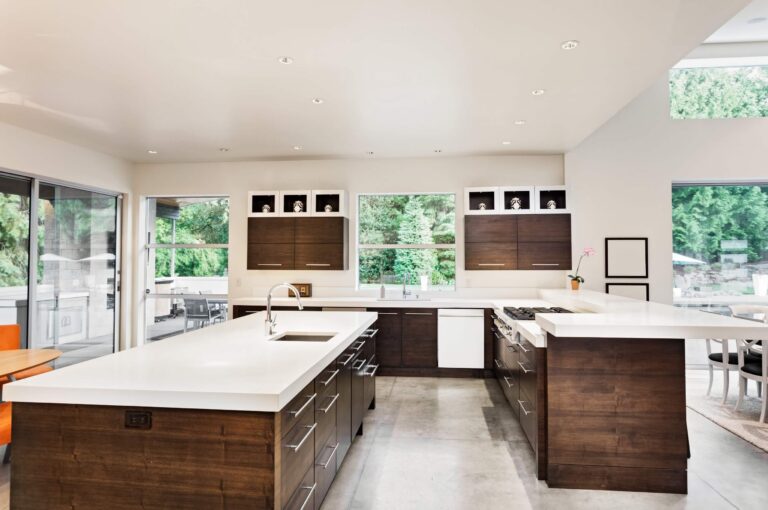
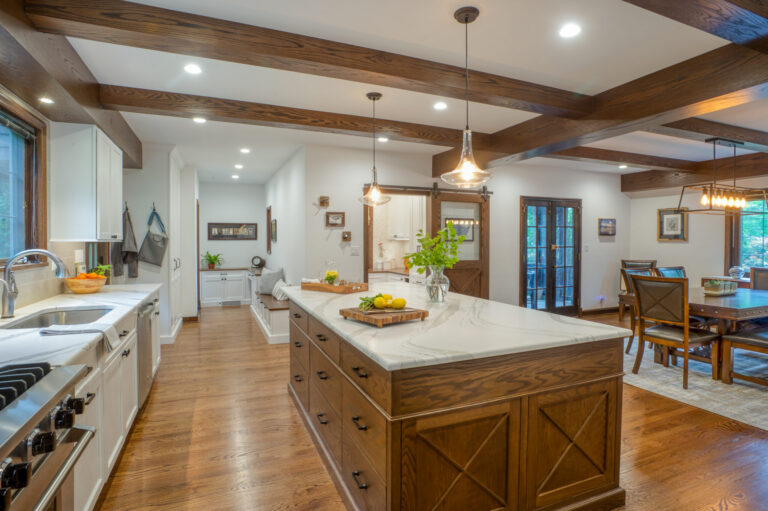
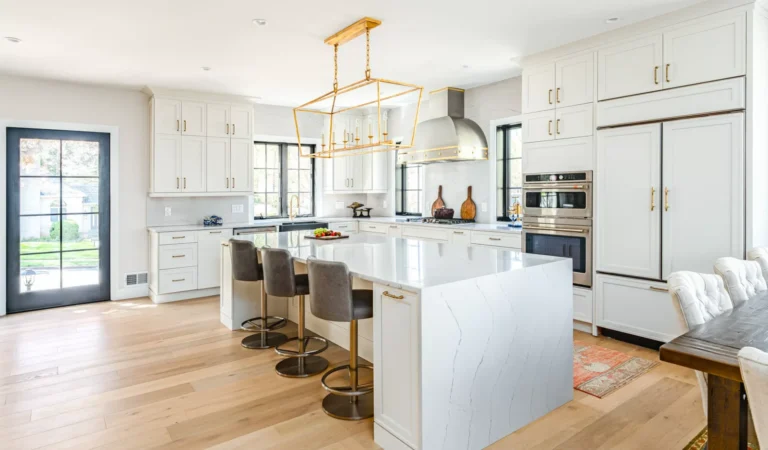
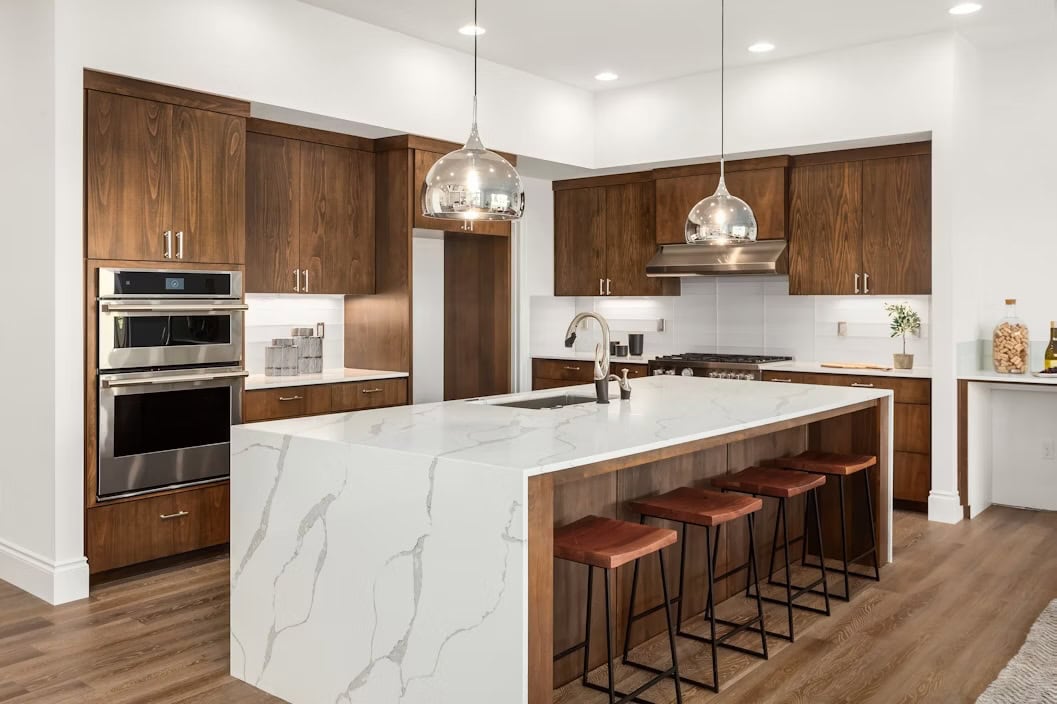
Island configurations add a freestanding, independent unit to L-shaped or single-wall layouts. This creates a multi-directional workspace where users can face outward toward the living or dining areas.
Islands are highly customizable. They can house sinks, cooking surfaces, or specialized under-counter refrigeration units. The trade-off is spatial; islands require at least 42 to 48 inches of clear walkway on all sides, meaning they are rarely suitable for tight, enclosed floor plans.
| Layout Configuration | Primary Spatial Advantage | Core Engineering Challenge | Footprint Class | Critical Clearance Metric | Hardware Cost Multiplier |
| One-Wall | Zero corner losses, lowest cost | Linear workspace elongation | Minimal | 36″ minimum walkway | Baseline (1.0x) |
| Galley | Peak ergonomic pivot efficiency | Parallel door collision risks | Compact | 48″ between faces | Low (1.1x) |
| L-Shape | Natural open-plan integration | Single corner access loss | Moderate | 42″ entry corridors | Medium (1.3x) |
| U-Shape | Maximum continuous counter area | Dual corner engineering requirement | Large | 60″ central clearing | High (1.6x) |
| G-Shape | Extreme storage density scaling | Single-point traffic entrapment | Extended | 36″ pinch points | Very High (1.8x) |
| Island Pivot | Multi-directional workflow routing | Utilities routing through slab | Variable | 42″ perimeter aisles | Custom (2.0x+) |
Evaluating which option to implement requires a logical assessment of the existing architectural space. A long, narrow room should use a galley or one-wall setup to protect essential walkways. A large, open room is better suited for an L-shape or island pivot configuration, allowing designers to utilize the open square footage effectively without stretching the work stations too far apart.
Real-World Spatial Scenarios and Case Studies Best Cabinet Layout Options
Scenario 1: The Urban Micro-Condo (90 Square Feet)
In a small urban apartment with a total kitchen footprint of 90 square feet, the architectural boundaries are rigid, with a fixed main plumbing stack on a single back wall. Attempting to force an L-shaped layout into this space would block the primary entry corridor and create a deep, unusable corner against the plumbing access panel.
The optimal choice is a tailored one-wall configuration using extra-tall, 42-inch upper units that extend to the ceiling. This approach shifts storage to the tertiary vertical zone, freeing up the baseline floor area.
A secondary failure mode can emerge if a standard 36-inch deep refrigerator is installed here, as it will jut into the primary walkway. To avoid this, planners must use a counter-depth, 24-inch wide integrated refrigeration column, preserving a clear, unencumbered pathway through the space.
Scenario 2: The Suburban Open-Plan Renovation
A mid-century suburban home features a load-bearing wall separating a dark, enclosed kitchen from the main dining room. The renovation plan removes this wall to integrate the spaces, creating a large, open 240-square-foot room. If a standard U-shaped layout is placed along the remaining walls, the cooking zone ends up too far from the living area, forcing the user to face away from family and guests.
The ideal solution is an open L-shaped layout anchored by a substantial 9-foot central island. This island serves a dual purpose: it houses the primary preparation sink and trash systems on the working side, while providing counter-height seating on the outer edge.
The mechanical challenge involves routing the drain line and electrical lines through an existing concrete floor slab. This requires precise core drilling and trenching before installing the base cabinetry units.
Scenario 3: The Historic Galley Update
A narrow historic townhouse contains a long kitchen space with large windows at one end and a historic brick chimney breast on the opposite side. This space is best served by a classic galley configuration.
However, because the chimney breast reduces the room’s width to just 8 feet for a brief section, standard 24-inch deep base units on both sides would narrow the walkway to less than 36 inches. This would create a dangerous pinch point near the main cooking surface.
To resolve this constraint, designers can use a mixed-depth strategy. One side of the room uses standard 24-inch deep bases to accommodate the main range and cleaning sink, while the opposing wall uses shallow 12-inch deep base units configured with specialized rollout pantry storage. This hybrid setup opens up the central walkway to a comfortable 48 inches while maximizing the storage capacity of the narrow room.
Planning, Capital Allocation, and Resource Dynamics
Evaluating the financial viability of a cabinetry project requires moving past simple linear-foot estimates. Standard pricing guidelines often overlook hidden complexities, such as customized modifications, specialized pull-out hardware, integrated appliance panels, and on-site scribing adjustments.
To allocate capital effectively, financial tracking should separate the costs into distinct investment classes. This allows project managers to balance material longevity against immediate budgetary limits.
The total cost of an installation includes the raw manufacturing expenses, specialized site labor, and the structural preparation of the room. Investing in premium frameless cabinetry with full-extension undermount drawer glides often carries a higher initial cost. However, this investment offers long-term financial advantages. It increases storage efficiency by up to 20% compared to traditional framed units, and extends the mechanical service life of the hardware, reducing future replacement risks.
| Investment Class | Manufacturing Methodology | Primary Material Core | Typical Lifespan (Years) | Hidden Installation Costs | Structural Flex Capacity |
| Stock Modular | Mass Assembly Line | Low-Density Particleboard | 5–10 | High shimming/scribing labor | Very Low |
| Semi-Custom | Batch-to-Order Production | Medium-Density Fiberboard | 15–25 | Extended filler strip requirements | Moderate |
| Bench Custom | Individual Articulated Build | Furniture-Grade Plywood | 40–60+ | Custom site-scribing integrated | High |
Design Tools, Technical Strategies, and Planning Aids
Modern space planning has moved far beyond hand-drawn grid paper and manual scale rulers. Locating opportunities and avoiding hidden interference vectors requires a combination of digital diagnostic software, physical mockups, and precise measuring instruments.
-
Parametric 3D Modeling Software: Programs like Chief Architect or 2020 Design allow designers to build precise digital twins of a room. This software runs automated collision checks to ensure that cabinet doors, drawers, and appliance panels can open fully without hitting adjacent trim or hardware elements.
-
Point-to-Point Laser Measures: Digital laser tools allow planners to capture dimensions across irregular or out-of-plumb walls. This ensures that manufacturing dimensions account for real-world variances rather than idealized architectural blueprints.
-
Full-Scale Cardboard Mockups: For complex, non-standard island geometries or tight clearances, assembling full-scale structural cardboard models on-site helps clients physically test traffic flows before approving final manufacturing orders.
-
Digital Incline and Level Telemetry: Electronic smart levels identify subfloor variances, wall bows, and ceiling sags. This data allows installers to plan for custom base leveling platforms and extended crown moldings before delivery day.
-
Appliance Specification Ledgers: A unified document that tracks the exact voltage, cut-out dimensions, ventilation clearances, and door swing physics of all integrated appliances. This ledger ensures the cabinetry framework accommodates necessary mechanical connections without modification.
-
Interior Hardware Mapping Catalogs: Detailed component guides from manufacturers like Blum or Hafele. These catalogs help designers specify internal lift-systems, soft-close hinges, and corner pull-out mechanisms based on the precise weight capacities required for each unit.
Risk Landscape and Failure Modes in Spatial Planning
Large-scale cabinetry installations can introduce new structural and functional vulnerabilities if planned in isolation. When design teams modify layouts to maximize storage without considering the broader mechanical context, they often trigger unintended secondary consequences. For example, placing a high-volume French-door refrigerator directly next to a deep wall corner can create a common failure mode. If the layout does not include a wide filler strip next to the wall, the refrigerator door cannot open past 90 degrees. This prevents interior crisper drawers from sliding out, rendering a key appliance feature useless.
The trend toward installing expansive, unbroken runs of heavy stone countertops on long island configurations introduces structural risks as well. If an island spans more than 8 feet without an engineered interior support frame, the weight of the stone can cause standard base cabinets to bow over time. This compression deforms the cabinet boxes, leading to binding drawer glides and misaligned door reveals.
Furthermore, poor planning around integrated under-counter waste pull-outs can introduce air quality challenges. If these pull-outs are placed directly adjacent to hydronic heating lines or under-floor radiant grids, the localized heat transfer can accelerate organic decomposition inside the bins, leading to persistent odors that require complete mechanical relocation to fix.
Governance, Long-Term Maintenance, and Adaptation Protocols
An effective cabinetry installation should not be treated as a static asset. It operates as a mechanical system that requires routine adjustments and monitoring to preserve its alignment and utility over decades.
High-use drawers and heavy pantry pull-outs experience continuous structural stresses that can cause mounting screws to loosen and door hinges to sag. To counter this natural wear, property owners should implement a structured review cycle to maintain functional efficiency.
A layered maintenance checklist ensures that structural and mechanical integrity is preserved across all components:
-
Casework Boxes: Inspect internal corner brackets and check for moisture swelling under sink bases every six months.
-
Drawer System Components: Vacuum dust from low-level slide tracks annually and re-torque mounting screws on heavy pull-out units.
-
Hinge Assemblies: Utilize integrated three-way adjustment screws every twelve months to correct door margins and prevent faces from rubbing against each other.
-
Material Surfaces: Apply specialized wood conditioners or inspect edge-banding adhesion on thermofoil units annually to prevent delamination from ambient heat exposure.
Measurement, Tracking, and Spatial Evaluation Metrics
Evaluating layout success requires moving past simple visual assessments. Accurate tracking relies on spatial performance indicators that isolate functional utility from subjective style preferences.
Leading indicators include clearance margin consistency, reach efficiency ratios, and traffic bypass dimensions. These metrics offer real-time data on whether an installation will perform reliably during peak household activities, ensuring that unmanaged layout choices do not cause daily frustration.
Lagging indicators, such as long-term finish wear or finish degradation near steam vents, provide an empirical measurement of spatial success over time. To ensure data integrity, designers can maintain structured project records during the planning phase. For example, a clearing ledger might record the physical distance between opposing drawer faces when fully extended.
An appliance swing log can track the intersection paths of open oven doors against passing traffic. Finally, an electrical distribution plan records the locations of internal outlets within appliance garages, ensuring that high-draw countertop units do not overload local branch circuits.
Common Misconceptions and Planning Oversimplifications
The public discussion around kitchen planning is filled with persistent myths that run counter to ergonomic science and structural reality. The idea that a kitchen must always use a traditional work triangle is outdated; modern open-concept homes often perform better with a zone-based setup that accommodates multiple cooks at once.
Similarly, the belief that maximizing the linear footage of cabinetry always improves a home ignores workflow dynamics. Adding unnecessary units can crowd a floor plan, leaving inadequate walkways and creating a cramped, dysfunctional environment.
Another common misconception is that standard filler strips represent a waste of valuable storage space. In reality, these small gaps are essential engineering components. They provide the necessary clearance for drawers to slide past proud door casings, and allow wall units to open fully next to out-of-plumb structural walls.
There is also a mistaken belief that frameless cabinetry is inherently less durable than traditional face-framed boxes. While framed units offer a classic look, modern frameless cabinetry made from high-density plywood or particleboard provides excellent structural stability and up to 15% more usable interior storage by eliminating the obstructive perimeter frame.
Contextual, Material, and Sustainable Considerations
The materials specified for modern cabinetry installations rely on global supply chains that face complex environmental and economic challenges. Hardwood timber extraction requires careful forest management to prevent habitat degradation, while the production of performance resins and binders for composite wood products can release volatile organic compounds if unmanaged.
Furthermore, the manufacturing of high-performance internal hardware mechanisms requires significant energy inputs, creating an environmental footprint that must be balanced by decades of reliable service life.
An integrated material framework links sustainable forestry harvesting directly to low-emission processing. This step is followed by rigorous mechanical durability testing to confirm long-term wear resistance. Selecting materials with low formaldehyde emissions and sourcing lumber certified by recognized bodies like the Forest Stewardship Council helps ensure that a project supports healthy indoor environments and sustainable resource use.
Strategic Synthesis and Future Design Pathways
Successfully optimizing a cabinetry layout requires looking past temporary design trends and focusing on a long-term, systems-level approach to interior architecture. Property owners cannot achieve lasting spatial efficiency through impulsive material selections or uncoordinated appliance placement.
Real, verifiable usability demands an intellectually honest layout strategy. This strategy must respect the physical constraints of the floor plan, adapt to changing household needs over time, and establish a clear balance between storage density and comfortable movement. Managing layout options is a continuous discipline that connects material engineering with human behavior and practical financial planning.
Looking forward, the evolution of residential storage design will be defined by the transition toward adaptable, responsive environments. As homes incorporate smaller footprints and flexible living patterns, cabinetry will evolve from fixed, static boxes into multi-functional, modular systems.
The most successful configurations will be those designed for long-term adaptability—frameworks that use adjustable internal fittings, accommodate future technology upgrades, and maintain clear traffic paths to handle an evolving domestic lifestyle.