Top Kitchen Contractor Plans: A Master Blueprint for High-End Renovations
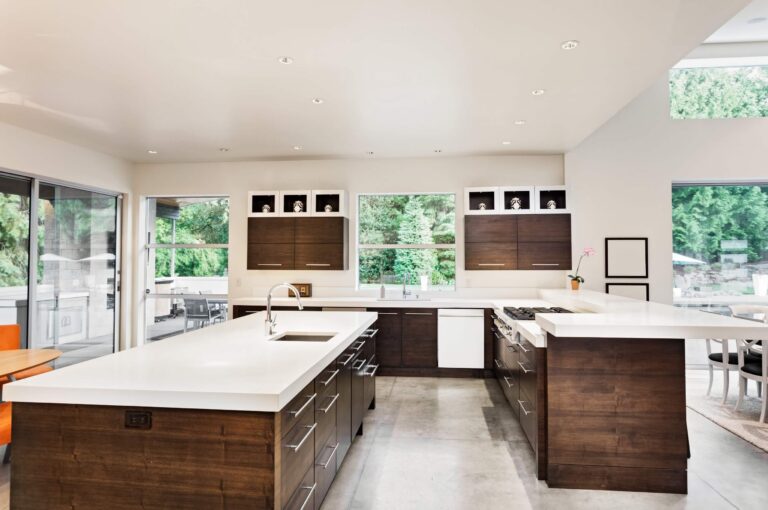
The modern high-end residential kitchen has long outgrown its traditional designation as a mere culinary workstation. In contemporary residential architecture, the kitchen represents the most technologically complex, logistically dense, and capital-intensive square footage within the structural envelope. Managing a transformation at this scale is an exercise in multi-disciplinary systems engineering, requiring the precise alignment of structural load paths, complex mechanical distribution, customized millwork detailing, and luxury appliance specification. Top Kitchen Contractor Plans. When a project moves past superficial aesthetic modifications and enters the realm of systemic structural alteration, the reliance on vague design concepts or casual construction notes inevitably leads to operational gridlock.
The structural friction inherent in luxury residential remodeling stems from a fundamental mismatch between design aspirations and site realities. High-profile spatial concepts—such as seamless indoor-outdoor floor transitions, expansive structural spans that eliminate load-bearing partitions, and fully integrated hidden ventilation networks—demand absolute spatial tolerances that standard residential framing cannot accommodate. Without an unyielding, technically precise blueprint to govern the process, minor site variations quickly compound. A millimeter deviation in a structural steel layout can easily cascade through the project, resulting in misaligned custom cabinetry runs, fractured stone counter slab seams, and uncalibrated plumbing rough-ins that ultimately inflate both timeline and budget.
To prevent these distributed failures, sophisticated project managers, architects, and estate allocators must transition away from fragmented construction documents and embrace unified execution strategies. This analytical study serves as a definitive reference for breaking down the technical requirements, structural liabilities, and organizational frameworks that govern successful premium kitchen renovations. By prioritizing rigorous structural mechanics, precise spatial logic, and strict change-management protocols, this guide outlines the operational standards required to successfully execute intricate residential construction projects from inception to final occupancy.
Top Kitchen Contractor Plans
The phrase “top kitchen contractor plans” is frequently trivialized in consumer design media, where it is often reduced to basic layout illustrations, finish selections, or color boards. Within professional interior architecture, structural engineering, and high-end construction management, however, the concept demands a far more rigorous technical definition.
A proper analysis of these advanced blueprints begins with understanding the hierarchy of structural integration, acknowledging that structural load paths must be calculated before mechanical paths can be routed. Below this engineering layer lies the precise coordination of millwork and spatial tolerances, where custom cabinetry, integrated appliance profiles, and architectural finishes must align down to the fraction of an inch. Finally, the operational layer details the sequencing of construction trades, site climate controls, and dust containment procedures. True mastery of this process requires evaluating how changes to a single wall or utility line affect the building envelope as a whole.
When interpreting detailed contractor plans, inexperienced owners often mistake detailed finish schedules for true construction blueprints. A rendering showing premium marble and custom white oak cabinets may look complete, yet it is operationally useless without underlying details like floor slab dead-load limits, wall-stud framing depth confirmations, and gas line sizing metrics. Implementing these complex plans requires balancing clear trade-offs across different sub-trades.
The Architectural and Technical Evolution of Residential Kitchens
The physical layout and structural role of the residential kitchen have been completely transformed over the past century. Early twentieth-century kitchens were deliberately designed as isolated, utilitarian service spaces tucked away at the rear of the home. Because these spaces prioritized basic function over comfort, their construction relied on simple, straightforward utility loops and standard nominal wall framing, with little consideration given to aesthetic spatial flow or multi-zone lighting design.
The mid-century shift toward open-plan residential layouts fundamentally disrupted this isolated design model. As barriers between the kitchen, dining, and living rooms were dismantled, the kitchen was forced to evolve into a highly visible architectural focal point. This spatial openness introduced serious engineering challenges. Eliminating partition walls required replacing load-bearing studs with long-span structural headers, often necessitating custom-fabricated steel I-beams or engineered micro-laminated timber (LVL) beams. This shift forced general contractors to develop more sophisticated structural shoring techniques and precise floor-leveling strategies to handle the new concentration of structural loads.
In the current premium market, this evolution has accelerated into an era of deep technological integration and commercial-grade performance within residential spaces. Modern kitchens frequently feature multi-kilowatt induction cooktops, built-in steam ovens, commercial-capacity walk-in refrigeration units, and complex automation networks. This heavy utility concentration places unprecedented demands on residential MEP infrastructure, requiring dedicated sub-panels to manage higher electrical currents, specialized large-diameter gas lines, and high-volume multi-zone makeup air systems to balance powerful range hoods. Consequently, modern construction documents must function less like simple carpentry guides and more like industrial coordination blueprints.
Core Conceptual Frameworks and Spatial Mental Models
To successfully execute a premium interior transformation without inducing structural or operational delays, engineering teams and project managers must move past casual spatial arrangements and rely on established mental models rooted in ergonomics, physics, and critical path logistics.
The Thermal and Mechanical Zoning Model
The first mental model replaces the traditional “work triangle” with a more comprehensive multi-zone grid system. This framework organizes the kitchen layout into distinct, self-contained functional stations: food preservation, prep work, thermal cooking, plating, and waste management. Each zone is treated as an independent spatial node with its own specific structural and utility requirements.
The Tolerance Stack-Up Principle
Borrowed from precision mechanical engineering, the Tolerance Stack-Up framework evaluates how minor, acceptable dimensional deviations across different sub-trades can accumulate into catastrophic alignment failures. For instance, if a framing crew allows a wall to be out of plumb by an eighth of an inch, and the drywall installer adds another eighth-of-an-inch variation, the custom cabinetry installer will find it impossible to fit a zero-clearance integrated refrigerator into the remaining opening. High-performance construction blueprints mitigate this risk by defining explicit “shimming zones” and structural reveal gaps that absorb these natural site variances before they impact the final finish layer.
The Systemic Critical Path Strategy
This mental model governs construction sequencing by analyzing the physical dependencies between different building layers. If a project manager skips this step and orders custom stone slabs based on initial architectural drawings rather than actual as-built dimensions, the project faces a high risk of material waste and timeline delays when on-site structural adjustments alter the final island geometry.
Taxonomy of Structural Variations, Engineering Layouts, and Spatial Systems
Premium kitchen structural transformations are not uniform. Each variation features unique engineering trade-offs that dictate its priority within the master project schedule.
Structural reconfiguration layouts involve moving load-bearing walls, installing flush ceiling steel headers, or altering exterior building envelopes to introduce large panoramic windows. These interventions maximize spatial flow and natural light but require formal engineering wet-stamps, extensive temporary shoring arrays, and often complicate the routing of vertical mechanical lines through the floor system.
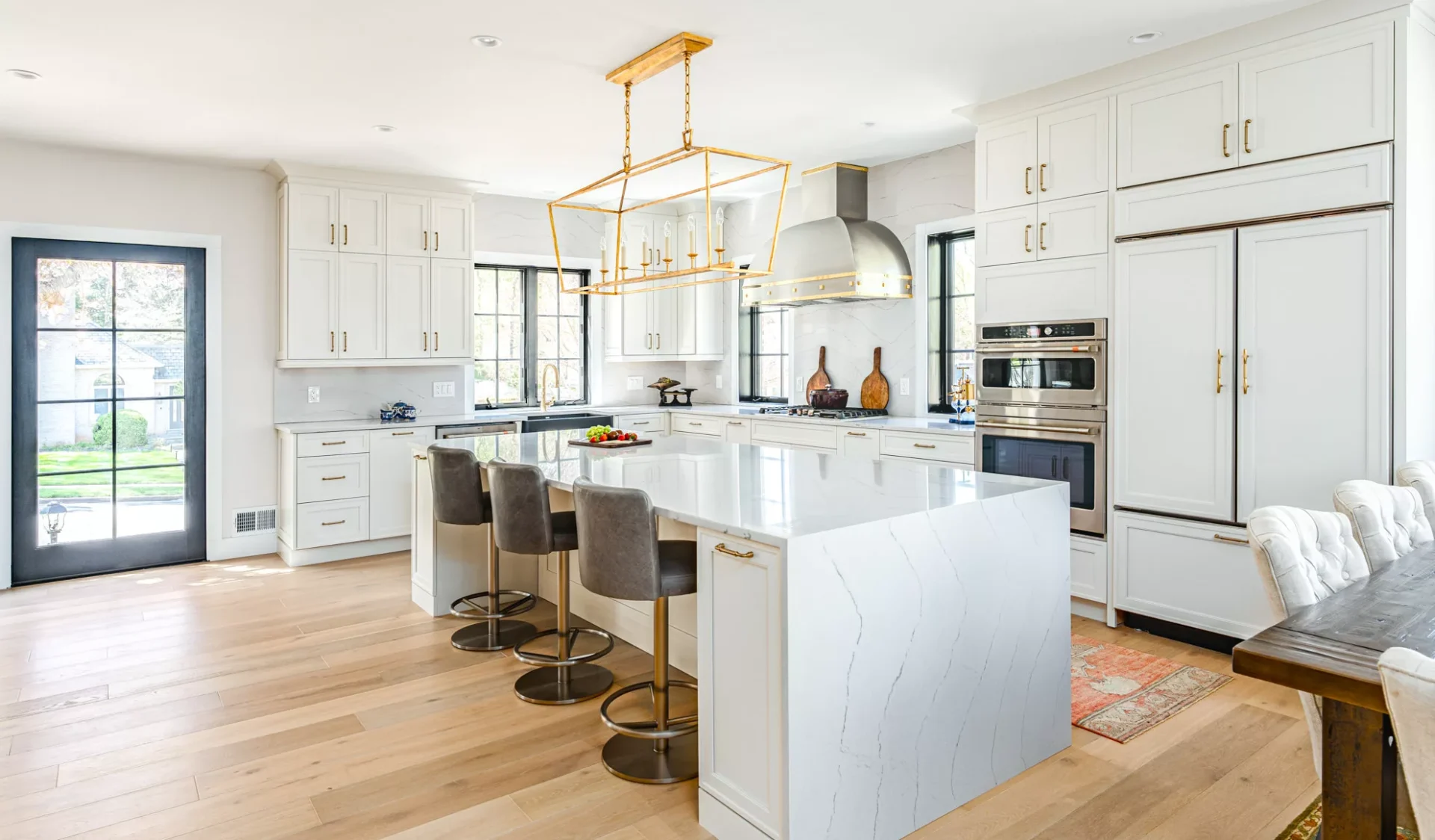
Integrated custom millwork designs focus on zero-clearance, full-height cabinetry runs that house fully integrated panel-ready appliances. This style creates a clean, architectural look where appliances blend seamlessly into the walls, but it demands absolute floor-level tolerances and requires specialized cooling channels built into the cabinet carcases to prevent appliance compressor overheating.
Commercial-grade utility setups prioritize raw performance, featuring high-output multi-zone gas or induction cooktops, commercial-volume salamander broilers, and integrated clean-water reverse osmosis filtration lines. This setup satisfies serious culinary needs but demands significant infrastructure upgrades, including high-volume makeup air systems to balance large range hood exhaust fans and dedicated high-voltage sub-panels.
| Plan Category | Primary Engineering Requirement | Initial Capital Intensity | On-Site Structural Disruption | System Lifespan (Years) | Key Secondary Risk Factor |
| Structural Reconfiguration | Custom steel header design, temporary shoring lines | High | Extreme | 50–100 | Foundation settling, drywall cracking |
| Integrated Millwork | CNC fabrication, zero-clearance tolerance tracking | High | Medium | 15–25 | Appliance replacement obsolescence |
| Commercial Utility | Dedicated sub-panels, makeup air integration | Moderate | High | 20–30 | Excessive acoustic noise, draft issues |
| Surface Architectural | Substrate stabilization, precise joint layouts | Moderate | Low | 10–20 | Substrate shifting, seam fracture |
Determining the ideal approach requires a careful assessment of the existing building structure. A historical estate with timber-frame joints requires a deep focus on structural stabilization and customized utility routing. Conversely, a modern steel-and-glass penthouse modification will center on integrated millwork tolerances and managing complex electrical power quality.
Detailed Real-World Scenarios and Construction Boundary Failures Top Kitchen Contractor Plans
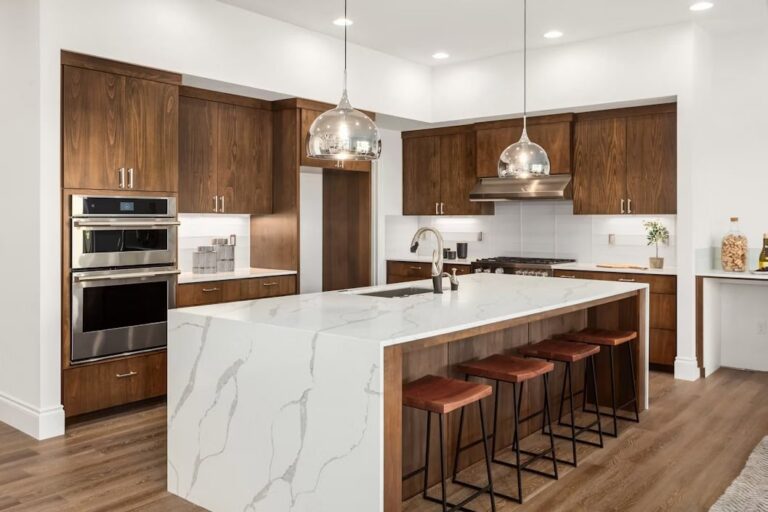
Evaluating the success of high-end kitchen executions requires moving past pristine architectural renderings and analyzing the chaotic realities of real-world job sites. Complications often arise from poor sub-trade coordination, environmental variations, or unexpected structural limitations. A common failure mode involves installing massive, single-piece stone island slabs without verifying the subfloor’s structural dead-load capacity. If top kitchen contractor plans call for a 1,200-pound quartzite countertop on a floor engineered only for standard residential live loads, the subfloor will deflect over time, causing custom cabinet doors to bind, floor tiles to crack, and the stone slab’s epoxy seams to fracture under the continuous stress.
In an island downdraft ventilation cascade failure, an architect specifies a high-output, popup downdraft vent behind a professional gas range on a kitchen island. The general contractor routes the heavy 10-inch rigid exhaust duct down through the floor system, only to discover a massive engineered joist directly in the center of the path. Rather than calling the structural engineer for a revised header plan, the framing crew cuts a large hole through the joist’s web. This unauthorized modification compromises the floor’s structural integrity, causing noticeable floor bounce in the living room above and triggering an immediate project shutdown during the next municipal building inspection.
Another common failure point involves improper coordination of zero-clearance integrated refrigeration panels. If a designer specifies panel-ready refrigerators without reviewing the manufacturer’s clearance templates, they may fail to account for the door’s structural hinge swing radius. This mistake requires rebuilding the surrounding cabinet tower, delaying the project completion by weeks and creating unexpected correction expenses.
Finally, uncoordinated makeup air systems highlight the vulnerability of modern high-volume ventilation.
Financial Architecture, Procurement Timelines, and Capital Allocation
Managing the financial flow of a premium kitchen project requires moving past simple square-foot cost estimates. High-end residential construction requires sophisticated capital allocation models that account for long-lead material procurement, volatile specialized labor costs, and realistic contingency reserves. Because a luxury kitchen renovation can involve significant capital investments, project coordinators use detailed cash-flow schedules tied directly to verifiable construction milestones rather than arbitrary calendar dates.
The overall cost profile of a project is heavily influenced by the procurement timelines of custom components. Imported natural stone slabs, European custom millwork, and professional culinary appliances often have lead times stretching from six to nine months. If these long-lead assets are not ordered during the early schematic design phase, the entire project timeline can stall, forcing the general contractor to extend site management overhead and inflating soft costs.
| Investment Category | Average Base Capital Draw | Specialized Labor Overhead | Procurement Lead Time | Primary Hidden Cost Vector | Project Risk Rating |
| Structural Shell | High | High | 4–8 Weeks | Unmapped plumbing in walls | Medium |
| Custom Millwork | Extreme | High | 16–26 Weeks | Site humidity climate controls | High |
| Professional MEP | Medium | Extreme | 6–12 Weeks | Utility main service upgrades | High |
| Architectural Stone | High | Medium | 8–12 Weeks | Slab structural fissure loss | Medium |
| Premium Finish | Moderate | Medium | 2–4 Weeks | Substrate leveling compounds | Low |
Specialized Diagnostic Instrumentation and Project Controls Equipment
Modern residential project controls have evolved past standard hand tools and manual measuring tapes. Successfully executing high-performance layouts requires a sophisticated toolkit of digital diagnostic instruments and precise site monitoring hardware. Multi-point rotary laser levels are essential for establishing absolute datum lines across uneven subfloors, ensuring that long cabinet runs sit perfectly level.
Digital pinless moisture meters are continuously deployed to monitor wood studs and subfloor moisture levels, ensuring the wood is dry enough to prevent warping before premium finishes or custom cabinetry are installed. For mechanical coordination, ultrasonic duct-testing fans verify the airtightness of complex exhaust loops, while thermal imaging cameras trace hidden hydronic radiant floor heating lines to prevent accidental punctures during floor anchoring.
The Risk Landscape: Structural Vulnerabilities and Material Degradation Top Kitchen Contractor Plans
Large-scale interior alterations can introduce hidden long-term structural risks if the surrounding home environment is not properly managed. When construction teams open up old walls to implement modern layouts without evaluating the building’s overall structural habits, they often cause unintended movement in adjacent rooms.
The use of wide, single-piece natural stone slabs also introduces permanent structural risks. Materials like marble and quartzite contain natural micro-fissures and mineral veins that are highly vulnerable to cracking if the underlying cabinet sub-base shifts even slightly. Furthermore, if top kitchen contractor plans fail to specify reinforcements for the subfloor with exterior-grade plywood and a proper decoupling membrane, the natural expansion and contraction of the wood joists will transfer directly into the stone seams, causing them to split. This risk is amplified if the home’s indoor climate experiences sharp humidity swings, which can warp premium millwork panels and cause custom mitered joints to separate.
Operational Governance, Quality Assurance, and Long-Term Asset Maintenance
A successful high-performance kitchen execution cannot be managed as a series of disconnected tasks; it must run under a continuous quality assurance framework. This requires clear milestone sign-offs and an explicit checklist system to protect the asset across its lifecycle. Project governance includes mandatory pre-construction alignment meetings between the framing, plumbing, and millwork crews, followed by formal framing inspections and comprehensive commissioning sequences before the space is turned over to the homeowner. To prevent performance drift, teams should use data-driven triggers, such as halting finish installations if the site’s relative humidity moves outside the safe 35% to 55% range.
A layered quality control checklist ensures that mechanical and structural integrity are preserved at every stage of construction. At the structural level, this involves verifying that joist sistering matches engineering specifications, checking that header deflections are within strict tolerances, and confirming that wall framing is perfectly square. Advanced utility governance requires pressure-testing gas lines, checking electrical circuits for proper grounding, and verifying that plumbing waste lines have the correct slope.
Quantitative Metrics, Tolerance Verification, and Data-Driven Commissioning Top Kitchen Contractor Plans
Evaluating construction progress must look past subjective visual opinions and rely on hard, measurable tolerances. Accurate project tracking uses explicit technical metrics that remove any ambiguity between sub-trades. Key indicators include wall flatness measurements (requiring less than an eighth-of-an-inch variance over a ten-foot straightedge), absolute floor levelness metrics, and cabinet face alignment tolerances down to a thirty-second of an inch. These strict guidelines give the project manager the authority to reject poor workmanship before it can affect downstream finishes.
Final project verification requires keeping an unchangeable site log. For example, a plumbing test log should record system pressure levels over a 24-hour window to prove there are no hidden micro-leaks behind expensive stone backsplashes. An electrical ledger must document the balance of current draws across the sub-panel to prevent future circuit breaker trips when multiple high-end appliances run simultaneously. Finally, an HVAC airflow ledger must record actual intake and exhaust cubic feet per minute (CFM) to verify that the makeup air system balances the kitchen’s air pressure, providing clear proof that the mechanical systems meet performance design standards.
Deconstructing Common Industry Myths and Remodeling Misconceptions
Similarly, the belief that any general carpenter can install imported European cabinetry ignores the reality that zero-clearance modern millwork requires specialized training, unique alignment tools, and millimeter-level precision that differ significantly from standard American face-frame carpentry.
Another frequent consumer error is assuming that appliance dimensions listed on retail websites are sufficient for ordering custom cabinets. True integration requires working from the manufacturer’s deep technical specification manuals, which outline essential details like exact electrical plug placement recess zones, door hinge articulation paths, and required ventilation airflow channels. There is also a persistent myth that open-concept layouts always make a home more functional. In reality, removing too many walls without a comprehensive acoustic design can turn a home into an echo chamber, where loud dishwashers and cooking noises disrupt the peace of adjacent living areas.
Supply Chain Lifecycles, Material Ethics, and Sustainability Constraints
The high-performance materials that define premium modern kitchens—such as exotic natural stone, specialty hardwoods, and complex electronic appliances—rely on global supply chains that face significant environmental and logistical challenges. Quarrying luxury stone like Italian Calacatta marble or Brazilian quartzite requires massive energy and water inputs, and transporting these heavy materials across oceans creates a substantial carbon footprint.
True construction planning must look past immediate aesthetic desires and adopt a holistic lifecycle approach. This includes prioritizing durable, repairable appliances over unserviceable consumer models, and selecting local, sustainably sourced materials whenever possible. Environmental analysis should consider the chemical emissions of cabinet adhesives and floor finishes, choosing low-VOC, water-based alternatives to protect indoor air quality. By insisting that top kitchen contractor plans specify sustainable materials, project teams can create spaces that are both exceptionally beautiful and environmentally responsible.
Strategic Synthesis: The Future of High-Performance Residential Interiors
Successfully executing top kitchen contractor plans requires moving past surface-level design trends and adopting a rigorous, systems-level approach to construction. Homeowners and project teams cannot achieve a flawless, long-lasting renovation through uncoordinated trade work or incomplete blueprints. Exceptional results demand an honest engineering strategy that respects structural limits, coordinates complex utility loops, and maintains strict management standards across every sub-trade on the job site. Managing a high-end renovation is a continuous balancing act that matches architectural vision with real-world physics, advanced logistics, and uncompromising quality control.
As kitchens incorporate advanced automated energy systems, touchless commercial-grade plumbing infrastructure, and fully hidden multi-zone ventilation grids, they will function less like traditional rooms and more like specialized, high-performance hubs. The most successful execution strategies will be those designed for long-term flexibility—blueprints that establish flawless foundational infrastructure, prioritize deep mechanical precision, and deliver an environment that remains resilient, beautiful, and highly functional for decades to come.