Modern Kitchen Remodeling Plans: Structural Architecture & Execution
The optimization of a residential food preparation environment requires a precise alignment of structural engineering, mechanical infrastructure, and spatial psychology. When executing a comprehensive interior overhaul, the development of modern kitchen remodeling plans determines how effectively a home handles daily functional stresses over several decades. This design phase establishes the invisible pathways for plumbing, electrical distribution, and HVAC circulation. It also dictates the physical boundary lines for casework and structural support. A project of this scale is rarely a simple aesthetic upgrade; it is a major spatial intervention that alters the core infrastructure of a property.
Historically, the kitchen operated as an isolated, utilitarian cell placed at the perimeter of the home. Modern architectural practices have dismantled these physical barriers, integrating food preparation zones directly into primary living and social areas. This open-concept transition introduces complex structural challenges. Removing load-bearing partitions requires installing engineered steel beams, recalculating point loads, and relocating major vertical utility stacks. Without a thorough analysis of these hidden systemic constraints, speculative design concepts will fail during the initial demolition phase.
A successful renovation depends on understanding how separate mechanical sub-systems interact within a fixed layout. Miscalculating electrical branch circuit capacities, gas line pressures, or drain slope requirements can create chronic performance bottlenecks. These errors delay project timelines, increase capital expenses, and reduce the long-term utility of the space. Consequently, navigating this process demands looking past superficial showroom trends. Planners must focus on the underlying principles of construction logic, spatial clearances, and mechanical sequencing.
This study analyzes the technical frameworks, financial dynamics, and risk landscapes that govern advanced residential renovations. By focusing on structural adaptations, infrastructure layout rules, and rigorous project management protocols, this guide serves as a definitive engineering and design reference. It helps architects, general contractors, and property owners execute resilient, high-utility space transformations.
Understanding “modern kitchen remodeling plans”
The term “modern kitchen remodeling plans” is frequently oversimplified in consumer media and marketing materials. It is often reduced to a visual mood board filled with stone samples, plumbing fixture finishes, and paint colors. Within the context of professional interior architecture and structural engineering, however, the concept demands a far more complex definition. It represents a systematic set of construction documents, mechanical schematics, structural engineering calculations, and material specifications. Together, these elements coordinate to transform an enclosed space without compromising the building envelope or violating local safety codes.
A complete planning process looks past visual trends to evaluate how infrastructure capacity matches the user’s operational needs. A specific plan may propose an impressive 10-foot waterfall island, yet fail completely if it blocks primary traffic paths or forces the main drain line to run too far from the waste stack. Therefore, developing successful plans requires identifying the specific structural limits of a home rather than relying on generalized design templates.
When evaluating these projects, planners often mistake a high material budget for intrinsic functional design. Sourcing exotic natural materials or high-end commercial appliances can quickly exhaust a capital allocation, yet provide little utility if the layout forces the cook to traverse a wide, inefficient path between work centers. Conversely, a highly organized plan with modest materials can achieve superior operational efficiency if it minimizes physical movement and aligns with natural human ergonomics. Implementing these adjustments requires balancing complex trade-offs across different systems. For example, installing heavy built-in appliance columns requires reinforcing the subfloor framing to handle the massive dead load safely.
The Socio-Technical Evolution of Domestic Workspaces
The organization of residential cooking areas was largely shaped by basic utility and fire isolation needs prior to the twentieth century. Early domestic spaces separated food preparation from the main house to keep heat, smoke, and odors away from living quarters. These setups relied on standalone wood stoves, dry sinks, and detached pantries. This approach shifted with the introduction of municipal water systems, natural gas lines, and organized studies of household efficiency.
The first major move toward standardized, integrated space planning occurred in the 1920s with the development of the Frankfurt Kitchen by Margarete Schütte-Lihotzky. This design applied contemporary factory optimization principles to the home, establishing uniform counter heights, built-in storage zones, and tight, efficient work paths. This approach treated the kitchen as a functional laboratory, proving that deliberate layout choices could drastically reduce the physical effort and time required for daily domestic tasks.
During the post-war housing boom of the 1950s and 1960s, manufacturing processes evolved to support mass-produced, modular cabinet units and standardized built-in appliances. This era introduced uniform dimensional increments, allowing builders to quickly specify and install continuous runs of base and wall units. However, because energy and building square footage were relatively inexpensive during this expansion, plans often prioritized rapid installation over custom spatial layout. This resulted in formulaic floor plans that frequently featured hard-to-reach corner cabinetry and poorly placed appliance centers.
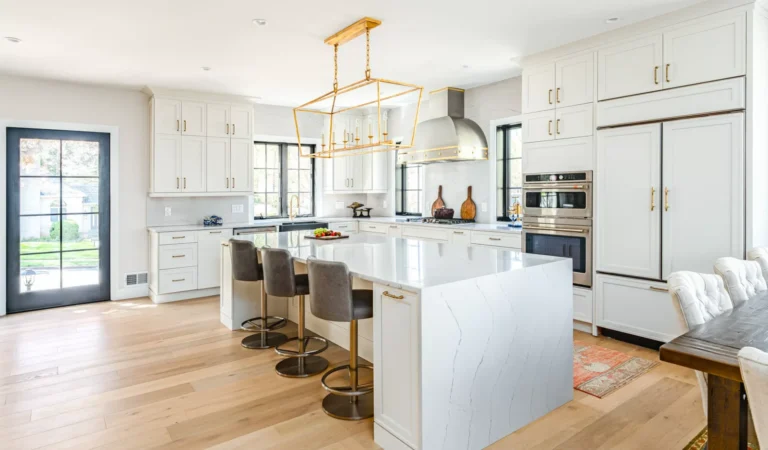
Today, the development of renovation plans faces a major shift driven by open-concept architecture and the integration of smart home systems. Modern living patterns have removed the physical walls separating preparation areas from dining and living spaces, meaning cabinetry and counters must function both as high-utility storage and as primary architectural elements that tie adjacent rooms together. This integration requires materials and layouts to handle heavy food preparation while managing noise, controlling air quality, and maintaining visual balance. As a result, contemporary planning has evolved from configuring a closed, isolated work cell into engineering an open, multi-functional zone that manages household traffic and coordinates complex mechanical systems.
Ergonomic Systems and Spatial Flow Models
To successfully analyze and implement renovation plans across diverse architectural conditions, designers must look past subjective visual preferences. They should rely on established mental models rooted in ergonomics and kinetic movement.
The Classic Work Triangle
The most enduring mental model for residential layout design is the Classic Work Triangle, developed in the 1940s by the University of Illinois School of Architecture. This framework connects the three primary activity centers: the refrigerator (cold storage), the sink (preparation and cleaning), and the range (cooking).
The model dictates that the sum of the three legs of the triangle should not exceed 26 feet, and no single leg should measure less than 4 feet or more than 9 feet. This geometric constraint ensures that the user can move efficiently between tasks without walking excessive distances, while still leaving enough counter space near each station to work comfortably.
Work Zone Theory
While the Work Triangle remains a useful baseline, modern spatial planning often uses Work Zone Theory to accommodate larger, open-concept spaces. This mental model divides the floor plan into five distinct functional zones:
-
Consumables (refrigerated and dry food storage)
-
Non-Consumables (dishes, glassware, and daily utensils)
-
Cleaning (sink, dishwasher, and waste management)
-
Preparation (continuous counter space, mixing tools, and spice storage)
-
Cooking (range, wall ovens, and specialized cookware)
By grouping cabinetry hardware, utilities, and organizers around these specific zones, designers can create self-contained work centers. This minimizes unnecessary movement across the room, allowing multiple users to operate simultaneously without crossing paths.
The Mechanical Path Model
The Mechanical Path Model treats a kitchen renovation as a complex infrastructure grid rather than a collection of furniture. This model tracks the flow of utilities—water supply lines, sewer drains, electrical currents, and gas vapors—from their main entry points through the room’s walls and floors.
Applying this framework means layout decisions are guided by the proximity to existing plumbing stacks and electrical panels. It recognizes that every foot an appliance moves away from its primary utility drop increases structural modification costs and introduces new potential failure points within the wall cavities.
The Clear Path Clearance Standard
The Clear Path Clearance Standard provides a framework for organizing walkways based on traffic volume and appliance door swings. Walkways are divided into three clear categories: single-cook corridors (minimum 42 inches wide), multi-cook passageways (minimum 48 inches wide), and primary building walkways (minimum 60 inches wide).
Applying this framework ensures that when an oven door or dishwasher rack is fully extended, a second person can walk past without stepping into a hazard zone. This minimizes daily physical friction and protects users from accidental burns or collisions.
Comprehensive Taxonomy of Renovation Frameworks
Renovation plans are not uniform. To deploy capital and structural resources effectively, projects must be categorized by their layout modifications, structural complexity, and mechanical changes. Each category features unique performance trade-offs that dictate its suitability for a given residential floor plan.
Cosmetic Transformations
Cosmetic transformations focus entirely on the surface layers of the room, leaving all structural walls and mechanical utilities in their original locations. This approach involves replacing cabinet doors, upgrading countertop materials, installing new backsplashes, and swapping out surface finishes.
The primary advantage of this strategy is its minimal impact on the home, low capital cost, and rapid completion timeline. The main trade-off is that it cannot fix underlying layout issues, cramped clearance zones, or structural infrastructure deficiencies.
Pull-and-Replace Upgrades
Pull-and-replace upgrades involve removing all existing cabinetry, countertops, and appliances down to the bare drywall or plaster walls. The new elements are installed within the exact same footprint, preserving the original plumbing, electrical, and gas connections.
This framework allows for significant storage optimization through modern frameless cabinetry and improved interior organizers. However, it prevents any structural wall removal or changes to the room’s basic traffic flow.
Structural Reconfigurations
Structural reconfigurations involve moving or removing non-load-bearing or load-bearing interior partition walls to alter the room’s physical shape. This strategy is essential for converting small, enclosed kitchens into open-concept spaces that connect with adjacent living areas.
The primary engineering challenge involves installing structural headers or steel columns to handle overhead floor loads. This requires specialized structural engineering sign-offs and advanced carpentry skills.
Complete Mechanical Relocations
Complete mechanical relocations involve gutting the space down to the bare wall framing and floor joists, followed by moving all major utility lines to entirely new positions. Sinks cross to the opposite side of the room, ranges move to central islands, and refrigeration columns shift to balance traffic flows.
This framework offers complete design freedom, allowing for perfect alignment with ergonomic work zones. The trade-off is financial; it requires extensive plumbing trenching, gas line extensions, and complete rewiring to meet modern electrical codes.
| Renovation Class | Structural Wall Modifications | Mechanical Utility Changes | Permit Rigor Class | Typical On-Site Timeline | Capital Allocation Index |
| Cosmetic Surface | None | None | Low / Excluded | 1–2 Weeks | Baseline (1.0x) |
| Pull-and-Replace | None | Minor appliance swap | Moderate | 3–4 Weeks | Medium (2.5x) |
| Structural Shift | Non-load partition removal | Moderate extension | High | 6–8 Weeks | High (4.5x) |
| Engineered Open | Load-bearing wall removal | Major utility rerouting | Full Structural Review | 10–12 Weeks | Extreme (7.0x+) |
Evaluating which framework to implement requires a logical assessment of the existing architectural space. A home with an efficient layout but worn materials should use a cosmetic or pull-and-replace strategy to protect capital reserves. A home with a cramped, dark floor plan that blocks natural light requires a structural reconfiguration or complete mechanical relocation. This allows designers to utilize the property’s total square footage effectively, even though it demands a higher initial investment.
Real-World Architectural Scenarios and Structural Pressures modern kitchen remodeling plans
Scenario 1: The Suburban Open-Concept Conversion
In a 1970s suburban home with a total kitchen area of 120 square feet, the space is isolated from the living room by a central load-bearing partition wall. The existing layout is a cramped U-shape that lacks adequate counter space and forces the cook to face a blank wall. Developing modern kitchen remodeling plans for this space requires removing the 12-foot load-bearing wall to open the view to the living area.
The optimal plan replaces the partition wall with an engineered LVL (Laminated Veneer Lumber) beam supported by new triple-stud columns at each end, which transfers the overhead floor load safely down to the foundation.
A secondary failure mode can emerge if the design team places the new main prep sink in the central island without calculating the drain line’s drop path. To maintain a proper 1/4-inch drop per linear foot, installers must cut a trench through the basement floor joists, reinforcing each penetration with steel joist hangers to preserve structural stability.
Scenario 2: The Urban High-Rise Condominium
An urban condominium features an 80-square-foot galley kitchen bounded by a solid concrete floor slab below and a rigid post-tensioned concrete ceiling above. The owner wants to move the cooktop from the perimeter wall to a new island to create a more open social environment.
In this scenario, drilling or trenching into the concrete slab to route a new gas line or high-voltage electrical conduit is strictly prohibited by building regulations. This constraint makes a traditional island relocation impossible.
To achieve an open layout within these rigid boundaries, the renovation plan must use a raised architectural podium or custom platforms to create a floor void. This platform allows electrical lines and mechanical feeds to route horizontally above the concrete slab, connecting safely to the existing wall utility drop without violating building codes.
Scenario 3: The Historic Timber-Framed Residence
A late-nineteenth-century historic home contains a spacious kitchen area with un-insulated exterior walls, balloon-frame wall studs, and uneven floor joists that sag up to two inches across the room. Attempting to install heavy stone countertops and custom frameless cabinetry directly onto these out-of-level surfaces would cause the cabinet boxes to twist, leading to misaligned doors and binding drawer glides.
The restoration plan must begin with structural leveling. The construction team must sister new, straight joists alongside the old timber framing, securing them with structural screws to create a flat, level platform for the new floor.
Furthermore, because balloon-frame homes lack internal fire blocking between floors, the renovation plan must include installing fire-retardant mineral wool batts within the wall cavities before hanging new drywall. This step seals the vertical paths between floors, bringing the historic building up to modern fire safety standards while preserving its architectural character.
Financial Architecture, Capital Allocation, and Resource Logistics
Evaluating the financial feasibility of a kitchen renovation requires moving past simple square-foot estimates. Project budgets frequently overlook hidden infrastructural expenses, such as upgrading the main electrical panel to handle new appliances, replacing hidden corroded galvanized piping, and correcting subfloor deflection.
To allocate capital effectively, financial tracking should separate expenditures into clear categories. This allows project managers to balance material quality against immediate structural needs.
The true cost of a project includes raw material procurement, specialized trade labor, permitting fees, and contingency reserves. Investing heavily in premium surface finishes while ignoring old, brittle plumbing lines inside the walls introduces significant long-term risk. If an old water pipe develops a pinhole leak after the project is complete, fixing it requires destroying the new custom tile and cabinetry, ruining the investment.
| Capital Allocation Category | Recommended Budget Allocation | Primary Financial Driver | Risk Factor of Under-Funding | Opportunity Cost Vector |
| Structural Infrastructure | 20% | Framing, leveling, subfloor prep | Early structural sagging | Prevents open floor integration |
| Mechanical Systems | 25% | Plumbing, electrical, HVAC | Code failure, system overloads | Limits high-performance appliances |
| Casework & Storage | 30% | Custom boxes, specialized hardware | Rapid mechanical wear | Reduces long-term storage capacity |
| Architectural Surfaces | 15% | Countertops, tile, floor finishes | Early surface scratching | Impacts home resale evaluation |
| Project Management | 10% | Permitting, engineering, logistics | Delays, structural fines | Increases on-site down-time |
Project Diagnostics, Technical Tools, and Planning Aids
Modern renovation planning has moved far beyond basic hand sketches and simple layout concepts. Identifying hidden infrastructure paths and avoiding structural interference requires a combination of digital diagnostic tools, physical testing kits, and detailed reference templates.
-
Digital Laser Scanning (BIM Integration): Handheld laser scanners allow field teams to capture complete 3D models of a room’s geometry. This data imports into architectural software, identifying out-of-plumb walls and uneven floors before custom cabinets are ordered.
-
Thermal Imaging Cameras: Infrared diagnostic tools used to scan finished walls. These cameras locate hidden hot-water lines, missing insulation pockets, and active electrical junctions without opening the drywall.
-
Wall Cavity Borescopes: Thin, flexible digital cameras inserted through small pilot holes in the drywall. They allow plumbers to inspect the condition of old drain stacks and framing bays before demolition begins.
-
Circuit Load Calculators: Software utilities used by electricians to assess the home’s total electrical demand. This step ensures that adding high-draw convection ovens or speed-cook units won’t overload the main electrical panel.
-
Subfloor Deflection Gauges: Mechanical measuring tools that track how much a floor bends under a heavy load. This testing determines if floor joists need reinforcement before installing heavy natural stone counters.
-
Duct Static Pressure Sensors: Diagnostic instruments used to check the airflow capacity of existing ventilation paths. This testing ensures the exhaust duct can handle the high-volume air movement required by professional-grade ranges.
Risk Landscape and Compounding Infrastructure Failures
Large-scale interior renovations can introduce structural and functional vulnerabilities if planned without considering broader environmental factors. When design teams focus on maximizing open space without analyzing the mechanical limits of the home, they often trigger compounding failure modes. For example, placing a high-capacity, 1200 CFM professional range hood over a central island without installing an engineered makeup air system can create a severe safety risk.
When the powerful exhaust fan turns on, it rapidly pulls air out of a sealed, modern home. This creates negative air pressure that can cause water heaters or gas furnaces to backdraft, drawing dangerous carbon monoxide vapors back down the chimneys and into the living spaces.
The practice of rerouting island plumbing lines beneath concrete floor slabs introduces structural risks as well. If a contractor trenches into a post-tensioned concrete slab without using ground-penetrating radar to locate the internal steel cables, they risk severing a high-tension tendon.
Such a break can cause immediate structural cracking across the slab, compromising the building’s foundation and requiring incredibly expensive specialized repairs. Furthermore, poor ventilation planning around built-in appliance garages can lead to mold issues. If high-use appliances like coffee makers or steam cookers are operated inside an enclosed wooden cabinet without automatic exhaust systems, the trapped moisture will rot the cabinet backing and ruin the custom woodwork.
Quality Governance, Material Inspections, and Site Protocols
An effective renovation project should not be managed through casual verbal agreements or loose site supervision. It operates as an active construction zone that requires systematic quality inspections and strict protocols to ensure all components align with safety standards.
High-use zones experience continuous structural and thermal stresses over time, making regular quality checks essential during the installation phase. Contractors should implement a structured inspection cycle to verify the accuracy of every system before closing up the walls.
A layered construction checklist ensures that structural and mechanical integrity is maintained across all phases of the project:
-
Framing Phase: Check that all stud bays are square, verify header spans match engineering specs, and ensure sistered joists are fully secured.
-
Mechanical Rough-In Phase: Pressure-test all new water lines at 150 PSI for 24 hours, confirm gas lines show no pressure drop, and verify all electrical boxes contain the correct wire gauges for their breakers.
-
Insulation & Drywall Phase: Inspect vapor barriers for continuity, verify fire-rated drywall is used behind cooking zones, and check that all wall penetrations are sealed with fire-rated foam.
-
Casework Installation Phase: Use precision electronic levels to verify base rails are flat, ensure cabinet boxes are anchored securely to framing studs, and adjust door hinges for uniform margins.
Measurement, Tracking, and Spatial Evaluation Metrics
Evaluating the success of a kitchen renovation requires moving past simple visual style preferences. Accurate tracking relies on spatial performance indicators that isolate functional utility from subjective design choices.
Leading indicators include electrical circuit headroom, drainage flow velocity, and traffic clearance margins. These metrics offer real-time data on whether an installation will perform reliably during peak household activities, ensuring that unmanaged layout choices do not cause daily frustration.
Lagging indicators, such as long-term material stability or finish wear near steam vents, provide an empirical measurement of spatial success over years of use. To maintain data integrity, designers can maintain comprehensive project records during the planning phase. For example, a clearing ledger might record the physical distance between extended appliance doors and facing units.
A mechanical log can track the pressure drop across gas delivery lines when all burners are active. Finally, a electrical distribution plan records the locations of dedicated GFCI circuits, ensuring that high-draw countertop appliances do not overload local branch circuits or create safety hazards near water sources.
Industry Misconceptions and Structural Oversimplifications
The public discussion around kitchen remodeling is filled with persistent myths that run counter to building science and engineering reality. The idea that open-concept layouts are always superior to closed designs is a common oversimplification. While open spaces improve social flow and natural light, they remove valuable wall area needed for storage and vertical utility paths. They also increase ambient noise transmission and make it harder for HVAC systems to control cooking odors throughout the home.
Similarly, the belief that swapping old appliances for new energy-efficient models requires no infrastructure changes ignores basic electrical safety. Modern induction cooktops and built-in steam ovens often require dedicated 40-amp or 50-amp circuits. This demand can easily overwhelm older 100-amp electrical services, forcing an expensive main panel upgrade that was completely omitted from the initial project estimate.
Another common misconception is that plumbing fixtures can move anywhere in the room without affecting drainage performance. In reality, moving a sink away from the main vertical vent stack requires extending horizontal drain lines beneath the floor. If these lines lack the proper 1/4-inch per foot slope or use too many sharp elbow bends, they will suffer from chronic slow drainage and frequent clogs, requiring regular mechanical clearing to maintain functionality.
There is also a mistaken belief that custom cabinetry always outperforms standard modular units. While custom builds offer excellent design flexibility and fill irregular spaces perfectly, high-quality modular systems manufactured under strict factory quality controls often provide superior finish durability and more reliable hardware consistency than units assembled by hand on a local job site.
Supply Chain Dynamics, Building Regulations, and Sustainability
The materials specified for modern kitchen remodeling plans rely on global supply chains that face significant environmental and regulatory challenges. Sourcing custom cabinetry timbers requires careful forestry management to prevent habitat degradation, while producing performance resins and finishes for manufactured countertops can release volatile organic compounds if unmanaged.
Furthermore, shipping heavy stone slabs or specialized appliances across international transit lanes creates a significant carbon footprint. This environmental debt must be balanced by specifying materials built for long-term durability.
True environmental planning must look past surface appearance and evaluate the entire lifecycle of the kitchen. This means prioritizing durable construction techniques, such as mortise-and-tenon joints or dowel-aligned boxes, which resist structural failure and prevent premature disposal.
Selecting appliances with high Energy Star ratings and sourcing low-emission composite woods helps ensure that a project supports healthy indoor air quality and sustainable resource use. Additionally, verifying that demolition waste is sorted allows recyclable metals and structural timber to be diverted away from local landfills, reducing the project’s overall environmental impact.
Strategic Synthesis and Long-Term Spatial Paths
Successfully executing a kitchen renovation requires looking past temporary design trends and focusing on a long-term, systems-level approach to residential architecture. Property owners cannot achieve lasting spatial efficiency through impulsive material selections or uncoordinated appliance placement.
Real, long-term usability demands an intellectually honest layout strategy. This strategy must respect the physical constraints of the floor plan, adapt to changing household needs over time, and establish a clear balance between storage density and comfortable movement. Managing renovation plans is a continuous discipline that connects material engineering with human behavior and practical financial planning.
Looking forward, the evolution of residential storage design will be defined by the transition toward adaptable, responsive environments. As homes incorporate smaller footprints and flexible living patterns, kitchens will evolve from fixed, static zones into multi-functional, modular systems.
The most successful configurations will be those designed for long-term adaptability—frameworks that use adjustable internal fittings, accommodate future technology upgrades, and maintain clear traffic paths to handle an evolving domestic lifestyle.